
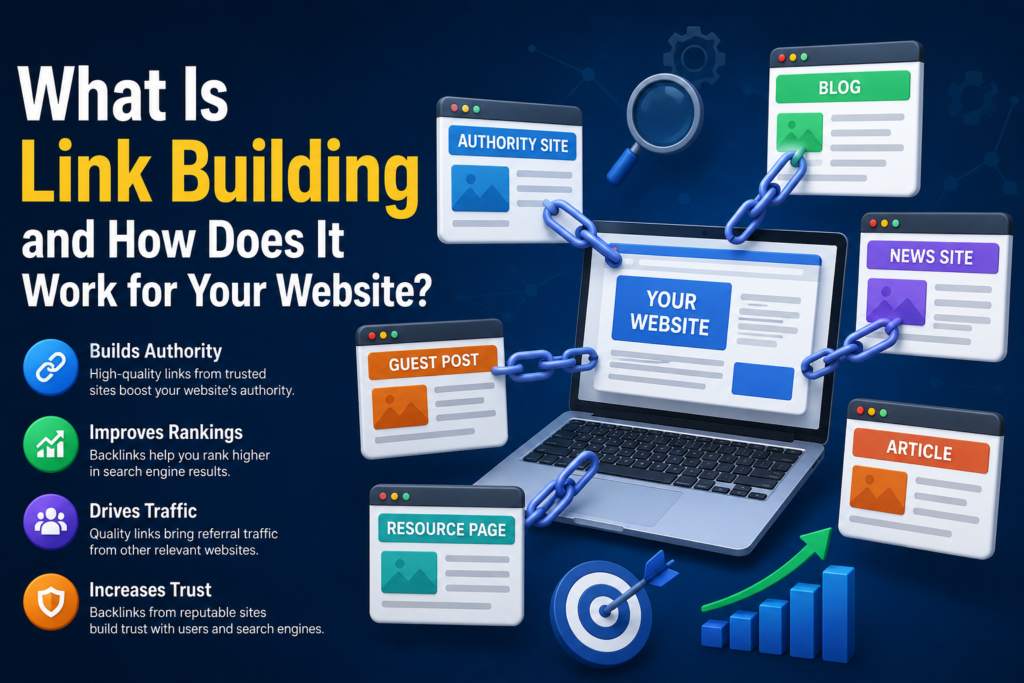
Link building is one of the most discussed parts of Search Engine Optimization (SEO). If you want your website to gain organic visibility on Google and other search engines, understanding backlinks and how they work is important.
In simple terms, link building is the process of earning or acquiring links from other websites that point to your website. These links are commonly called backlinks or inbound links.
However, modern link building is not simply about collecting as many links as possible. Search engines evaluate links in context, and a relevant, trustworthy, naturally placed link can be far more valuable than hundreds of irrelevant or manipulative links.
For website owners, bloggers, publishers, businesses, and SEO professionals, the real objective should be to build a strong website that other people and organizations genuinely want to reference.
This guide explains what link building is, how it works, why backlinks matter, what makes a backlink valuable, which strategies are worth using, and which practices can put your website at risk.
What Is Link Building?
Link building is the SEO practice of obtaining links from external websites to pages on your own website.
For example, imagine you publish an article called:
A cybersecurity website publishes an article about online privacy and naturally links to your VPN guide because it provides useful additional information.
That link from the cybersecurity website to your page is a backlink.
The basic structure looks like this:
Other Website → Backlink → Your Website
Backlinks can potentially help search engines discover pages, understand relationships between websites and content, and evaluate signals associated with authority and relevance.
But a backlink does not automatically mean that your page will rank higher.
Google uses many different systems and signals when determining search results. Links are only one part of the overall SEO picture.
Why Are Backlinks Important for SEO?
Links have played an important role in Search Engine Optimization for many years.
One major concept associated with Google’s early ranking systems was PageRank, which used links to help assess the importance of web pages.
The basic idea was relatively simple: when pages link to other pages, those links can provide information about relationships and importance.
Modern Google Search is much more sophisticated than the original PageRank system. Nevertheless, links remain an important part of how the web is connected and how search engines discover and evaluate content.
Backlinks can provide several potential benefits.
1. Search Engine Discovery
Search engine crawlers can discover URLs through links.
If another website links to a page on your website, that link can provide another pathway for search engines to find the page.
This is particularly useful for discovering new content.
2. Referral Traffic
A backlink isn’t only useful for SEO.
If a popular website links to your article, readers may click the link and visit your website.
This is called referral traffic.
For example, if a technology publication links to your detailed smartphone guide, readers interested in smartphones may click through to your website.
3. Authority and Reputation
Relevant links from reputable websites can contribute to your website’s overall authority signals.
However, “authority” should not be treated as a simple score where collecting more links automatically makes your site stronger.
The quality, relevance, context, and nature of links matter.
4. Brand Exposure
Even when users don’t click a link, being mentioned on reputable websites can increase awareness of your brand.
Over time, brand exposure can lead to more searches, direct visits, citations, and organic mentions.
How Does Link Building Work?
A simplified link-building process looks like this:
Create valuable content → Promote or distribute it → Relevant websites discover it → Some websites reference it → Your site earns backlinks
For example, suppose you operate a technology website.
You publish a detailed research report:
Internet Privacy Trends in 2026
The report includes original statistics, charts, expert commentary, and useful explanations.
You promote the research to technology publications, cybersecurity writers, journalists, and industry websites.
If those publishers find the research useful, they may reference your report in their own articles.
Each relevant editorial reference can create a backlink.
This is an example of earning links through useful content rather than simply buying links.
What Makes a High-Quality Backlink?
Not all backlinks are equal.
A strong backlink generally has characteristics that make it useful to both users and search engines.
1. Relevance
Relevance is extremely important.
Suppose you have a website about technology.
A backlink from a reputable technology or cybersecurity website is naturally more relevant than a backlink from an unrelated website about gardening, gambling, or another completely unrelated topic.
For example:
Technology Website → Technology Guide
makes logical sense.
But:
Random Website → Technology Guide
may have little contextual value.
2. Editorial Context
A link placed naturally within useful content is generally more meaningful than a link placed randomly in a website’s footer, sidebar, or unrelated page.
For example:
According to this detailed SEO link-building guide, websites should focus on earning relevant editorial references instead of purchasing large quantities of links.
The link is being used because it provides additional information to the reader.
That’s a natural editorial context.
3. Trustworthiness
The website providing the backlink should ideally be legitimate and trustworthy.
A link from an established publication, industry organization, university, professional website, or respected niche publisher can be much more meaningful than a link from a low-quality site created primarily for SEO manipulation.
4. Relevant Anchor Text
Anchor text is the clickable text used for a hyperlink.
Example:
Learn more about technical SEO.
“technical SEO” is the anchor text.
Anchor text can help users understand what they will find after clicking the link.
However, deliberately building hundreds of backlinks with exactly the same keyword-rich anchor text can look unnatural.
A natural backlink profile usually contains varied anchor text, including brand names, URLs, descriptive phrases, and natural language.
What Is a Backlink Profile?
Your backlink profile is the overall collection of links pointing toward your website.
An SEO professional may analyze things such as:
- Number of referring domains
- Relevance of linking websites
- Link placement
- Anchor text
- Link attributes
- Potentially harmful or suspicious patterns
- Growth over time
- Links to important pages
- Brand mentions
- Competitor backlink patterns
The number of backlinks alone doesn’t tell the full story.
For example:
Website A: 100 relevant backlinks from legitimate websites
Website B: 10,000 automated links from unrelated low-quality pages
Website B isn’t automatically stronger because it has more links.
This is why modern link building should focus on quality and relevance rather than quantity.
Do More Backlinks Mean Higher Google Rankings?
No.
This is one of the biggest misconceptions about link building.
Getting more backlinks doesn’t guarantee better rankings.
Google evaluates many aspects of a website and individual page, including relevance, content quality, technical accessibility, user experience, search intent, and other signals.
A website with fewer but highly relevant and naturally earned links can outperform a website with a huge collection of low-quality links.
The objective should therefore be:
Earn the right links, not simply more links.
Dofollow vs Nofollow Links
You may have heard SEO professionals discuss “dofollow” and “nofollow” links.
A normal hyperlink doesn’t necessarily contain a special link attribute.
A website can also use attributes such as:
rel="nofollow"
rel="sponsored"
rel="ugc"
These attributes provide search engines with information about the nature of a link.
Nofollow Links
The nofollow attribute was originally introduced as a way for websites to indicate that they did not want a particular link to be treated as a normal editorial endorsement.
Today, Google treats nofollow, sponsored, and ugc as hints about how links should be considered rather than absolute commands in every situation.
Sponsored Links
Paid or advertising-related links should appropriately use the sponsored attribute where applicable.
For example:
rel="sponsored"
This helps distinguish advertising relationships from ordinary editorial links.
UGC Links
UGC stands for User Generated Content.
This can be used for links posted by users in areas such as:
- Forums
- Comments
- Community pages
Example:
rel="ugc"
It is important to understand that a nofollow or UGC link isn’t necessarily “useless.” It can still generate referral traffic, exposure, discovery, and brand awareness.
What Is Internal Linking?
Internal linking is different from link building through backlinks.
An internal link connects one page on your website to another page on the same website.
For example:
Your website has:
- What Is SEO?
- What Is Link Building?
- Technical SEO Guide
- Best SEO Tools
Your “What Is SEO?” article can link to your “Link Building” article.
This helps:
- Users discover related content
- Search engines understand website structure
- Important pages receive internal links
- Readers navigate between related topics
- Your content forms logical topic clusters
Internal links are completely under your control, so they should be part of your SEO strategy even if you don’t have many backlinks.
The Best Link-Building Strategies
There are many ways to earn backlinks, but not every strategy is equally effective.
1. Create Link-Worthy Content
One of the strongest long-term strategies is to create content that people genuinely want to reference.
Examples include:
Original Research
Conduct surveys, collect data, analyze trends, and publish the results.
Statistics Pages
Create useful collections of updated statistics.
Detailed Guides
Publish comprehensive resources that answer a topic better than existing content.
Original Tools
Free calculators, generators, checkers, and useful online tools can naturally attract links.
Case Studies
Document real results and explain how you achieved them.
Industry Reports
Research-based reports can attract journalists, bloggers, and industry publications.
2. Digital PR
Digital PR combines public relations with online content promotion.
Suppose your website publishes original research about:
How AI Is Changing Small Businesses in 2026
You can distribute the findings to journalists and relevant publications.
If journalists use your research in their articles, they may reference your website.
Digital PR can generate:
- Brand mentions
- Referral traffic
- Editorial links
- Media exposure
- Industry recognition
The key is having something genuinely newsworthy or useful.
3. Guest Posting
Guest posting involves writing an article for another website.
For example, a technology writer might contribute:
How Businesses Can Improve Online Security
to a relevant technology publication.
If the host website allows an appropriate author or resource link, the article may generate a backlink.
However, guest posting becomes risky when the primary purpose is to manipulate search rankings.
Avoid creating hundreds of low-quality articles solely to insert backlinks.
The content should be valuable to the host website’s audience.
4. Broken Link Building
Broken link building involves finding relevant pages containing broken external links and suggesting a useful replacement.
For example:
A cybersecurity website has an article containing a link to an old resource that no longer exists.
You have created a high-quality updated resource covering the same topic.
You can contact the website owner and explain that their link is broken while suggesting your resource as a possible replacement.
The key is relevance.
Don’t send mass emails suggesting your page for every broken link you find.
5. Resource Link Building
Some websites publish resource pages containing useful external links.
For example:
If your SEO guide genuinely provides useful information for that audience, you may contact the publisher and suggest your resource.
Again, the resource should actually deserve inclusion.
6. Expert Contributions
Providing expert commentary can also generate visibility.
Journalists and publishers often need expert opinions for articles.
If you have genuine expertise in a subject, participating in relevant expert opportunities can result in brand mentions and potentially editorial links.
Avoid pretending to be an expert in areas where you have no legitimate experience.
What Is Link Bait?
Link bait refers to content deliberately designed to attract attention and earn backlinks.
Good examples include:
- Original research
- Interactive tools
- Unique statistics
- Industry surveys
- Interesting visualizations
- Controversial but well-supported analysis
- Comprehensive resources
For example, instead of publishing another generic article about “SEO Tips,” you could publish:
SEO Statistics: 100+ Search Trends and Data Points for 2026
If the information is genuinely useful and properly researched, other websites may reference it.
What Link-Building Practices Should You Avoid?
This is one of the most important parts of SEO.
Buying Links to Manipulate Rankings
Purchasing backlinks specifically to influence organic search rankings can violate Google’s spam policies.
Buying legitimate advertising or sponsorship placements is different, but paid links intended to manipulate rankings should be appropriately disclosed and tagged.
Automated Link Building
Avoid tools and services promising thousands of backlinks automatically.
Examples include:
- Automated blog comments
- Link farms
- Mass directory submissions
- Private spam networks
- Automated forum profiles
- Generated pages containing backlinks
These links usually provide little real value.
Excessive Exact-Match Anchor Text
Suppose your target keyword is:
best VPN services
Building hundreds of backlinks using exactly:
best VPN services
as the anchor text can create an unnatural pattern.
Natural link profiles usually have variation.
Private Blog Networks
Private Blog Networks, often called PBNs, involve networks of websites created or controlled primarily for manipulating search rankings through links.
This approach carries significant risks and is not a sustainable strategy for a legitimate website.
Are Guest Posts Still Useful in 2026?
Yes, but the purpose matters.
Guest posting can be useful for:
- Reaching a new audience
- Building relationships
- Demonstrating expertise
- Increasing brand awareness
- Generating referral traffic
- Earning legitimate editorial mentions
It becomes problematic when websites publish large quantities of low-quality guest posts purely for backlinks.
A useful rule is:
If the article would have no value without the backlink, reconsider the strategy.
The content should stand on its own.
How to Build Backlinks for a New Website
New websites often have limited authority, so trying to compete immediately for extremely competitive keywords can be difficult.
A practical strategy is to build a strong content foundation first.
Step 1: Select a Specific Niche
Don’t try to cover every topic on the internet.
Choose a clear subject area.
For example:
Technology → AI → AI tools and guides
This makes it easier to build topical relevance.
Step 2: Publish High-Quality Resources
Create useful articles that solve actual problems.
Step 3: Build Topic Clusters
Create several related articles and connect them using internal links.
Step 4: Promote Your Best Content
Don’t promote every page equally.
Identify your most useful resources and focus outreach on those.
Step 5: Build Relationships
Connect with:
- Industry publishers
- Journalists
- Bloggers
- Researchers
- Businesses
- Relevant communities
Real relationships can lead to natural mentions over time.
Step 6: Earn Links Instead of Chasing Numbers
Your goal should be to become a website that people want to reference.
How to Check Your Backlinks
Several SEO tools can help analyze backlink profiles.
Popular options include:
- Google Search Console
- Ahrefs
- Semrush
- Moz
- Majestic
Google Search Console can show links associated with your site, while third-party SEO platforms often provide additional competitive backlink data and filtering capabilities.
When analyzing backlinks, don’t focus only on the total number.
Look at:
- Referring domains
- Relevant websites
- Anchor text
- Link context
- Target pages
- Link attributes
- Suspicious patterns
- Referral traffic
Should You Remove Bad Backlinks?
Not every unwanted backlink requires action.
This is an important point because websites naturally accumulate links from many sources over time.
You may find:
- Spam comments
- Scraper websites
- Random directories
- Automatically generated pages
- Low-quality websites
The presence of such links doesn’t automatically mean that your website has been penalized.
Google has systems designed to neutralize many types of unnatural or spammy links.
The disavow tool is therefore not something most website owners should use routinely.
It is generally intended for specific situations, particularly where there is a substantial number of artificial or manipulative links and there is a need to address them according to Google’s guidance.
Link Building vs Link Earning
There is an important difference between the two concepts.
Link Building
You actively identify opportunities to obtain links.
Examples:
- Outreach
- Relevant guest contributions
- Broken-link outreach
- Resource-page outreach
Link Earning
People link to your website because they genuinely find your content useful.
Examples:
- Someone references your research
- A journalist cites your statistics
- A blogger recommends your guide
- A website references your original tool
The strongest long-term SEO strategy often combines both.
How Link Building Fits Into a Complete SEO Strategy
Backlinks should not be treated as the entire SEO strategy.
A successful website usually needs several components working together.
Content SEO
Create useful, original, search-intent-focused content.
On-Page SEO
Optimize:
- Titles
- Headings
- URLs
- Images
- Internal links
- Meta descriptions
- Structured content
Technical SEO
Improve:
- Crawlability
- Indexability
- Site architecture
- Mobile usability
- Page performance
- HTTPS
- XML sitemaps
Internal Linking
Connect related pages logically.
Link Building
Earn relevant external references.
User Experience
Make the website easy to navigate, read, and use.
When these components work together, backlinks can support a much stronger SEO foundation.
A Simple Link-Building Example
Imagine you run a website called TechExample.com.
You publish:
Best AI Tools for Small Businesses in 2026
Instead of immediately buying backlinks, you create supporting research:
AI Adoption Statistics for Small Businesses in 2026
You collect original data and publish a detailed report.
You then create related articles:
- What Is Generative AI?
- Best AI Writing Tools
- AI Tools for Marketing
- AI Automation for Small Businesses
- AI Security Risks
You internally link these articles.
Then you promote your original research to relevant technology websites and journalists.
Suppose five reputable websites reference your statistics and link to your research.
You now have five potentially valuable referring domains, along with brand exposure and referral traffic.
More importantly, you’ve created an asset that can continue earning links.
This is a much healthier strategy than purchasing 5,000 automated backlinks.
Frequently Asked Questions About Link Building
What is link building in SEO?
Link building is the process of acquiring links from external websites to your own website. These links are called backlinks and can help with discovery, referral traffic, visibility, and other SEO signals.
Are backlinks still important in 2026?
Yes. Links remain an important part of the web and search ecosystem, but backlinks are only one component of SEO. Relevance, quality, content, technical SEO, search intent, and overall website quality also matter.
How many backlinks does a website need?
There is no universal number. A website doesn’t need a specific number of backlinks to rank. The quality and relevance of the site’s content, competition, authority, and other factors are more important than reaching an arbitrary backlink target.
Are paid backlinks safe?
Buying links specifically to manipulate search rankings can violate search engine spam policies. Paid advertising and sponsorships should be handled transparently and use appropriate link attributes where applicable.
Do nofollow links help SEO?
Nofollow links can still provide referral traffic, exposure, brand visibility, and potential discovery. Google treats certain link attributes as hints rather than simply ignoring every such link in every circumstance.
Is guest posting good for SEO?
Guest posting can be useful when it involves genuinely valuable content published on relevant websites. Using large-scale, low-quality guest posting primarily to manipulate rankings is not a recommended strategy.
Can backlinks hurt a website?
Artificial or manipulative link schemes can create SEO risks. However, simply receiving a random low-quality link does not automatically mean your website will be penalized.
What is the fastest way to build backlinks?
There is no safe shortcut that guarantees ranking improvements. The most sustainable approaches involve creating link-worthy resources, relevant outreach, digital PR, original research, expert contributions, and genuine industry relationships.
Final Verdict: Is Link Building Worth It?
Yes, link building can still be an important part of SEO, but the old “more backlinks = better rankings” approach is outdated.
The real value of link building comes from earning relevant, trustworthy, contextually appropriate references from other websites.
A strong strategy focuses on creating content that deserves to be cited, promoting useful resources to the right people, building relationships within your industry, and avoiding manipulative link schemes.
Think about link building from a user’s perspective.
If a website links to your article because it genuinely helps its readers, that is a good reason for the link to exist.
If the only reason for the link is to manipulate Google’s rankings, the strategy is much riskier.
For long-term SEO in 2026, focus on quality over quantity, relevance over randomness, and genuine value over shortcuts.
The best backlink is not necessarily the one with the highest third-party SEO metric. It is often the link that puts your website in front of the right audience, provides useful context, and comes from a legitimate source that has a genuine reason to reference your content.
Recommended Sources for Further Reading
For a deeper understanding of link building and Google’s approach to links, website owners should refer to primary and established SEO resources, including:
- Google Search Central – SEO Starter Guide
- Google Search Central – Spam Policies
- Google Search Central – Link Best Practices
- Google Search Central – Qualifying Outbound Links
- Google Search Console documentation
- Ahrefs – Link Building resources
- Semrush – Link Building resources
- Moz – Link Building Guide
These resources can be used alongside Google’s official documentation because search-engine guidance and SEO practices can evolve over time.